The blossoms on our ice plant, like those on many other plants, open to the sun and close when the sun passes. As human beings, we are so like that. We open to warmth and light and close in on ourselves when we don’t feel it from others. We are the light of the world, Christ said. How can I be warmth and light to someone today? How can I help someone blossom and grow today?
This morning my husband asked why I haven’t mentioned that
he is the son of a gardener. So, here’s
to my husband and his papa.
My husband’s father was a wonderful man. As a Japanese American and U.S. Citizen, he worked in an import/export company in San Francisco prior to WWII. When the war broke out, he and his young family were transported to an internment camp. After the war, there was so much ill will toward Japanese Americans that he could only get work as a gardener. But he never complained and he never became bitter. He was a good husband and a good father. He came to love his own garden as a place of refuge and peace, and my husband learned a lot from him.
In our garden today, my husband does the heavy lifting. In recent days he eradicated an infestation of termites in one of our wooden posts and re-sealed the rest of them. He sawed off a dead branch from the tree in our shade corner, and he had the courtyard gate repaired. Throughout the year, he trims the bushes and inspects our stucco and roof for repairs. For all these things and many others, including saving the last of the blueberries for me yesterday, he is God’s gift to me.
Gardening is a great activity for recovering perfectionists like me. Although I can strive for perfection in the garden, I can never fully achieve it. Too many factors are outside of my control – wind, heat, and the unpredictable whims of the Master Gardener. That’s a good thing.
Like everyone else, I wrestle with a few unamusing things in life. However, in the garden I can control one thing. There is something REALLY satisfying about pulling weeds and seeing the garden free of them.
There is something about being in a garden that changes us. Whether or not we name it, we sense the presence of the Creator. It is as if there is a wonderful secret all around us that eludes our minds but speaks to our senses.
On this Solemnity of Pentecost, the poetic beauty of Psalm 104 glorifies the Creator and all of creation. Here are a few lines from the beginning of the Psalm:
"....O LORD my God, you are very great.
       You are clothed with honor and majesty,
wrapped in light as with a garment.
       You stretch out the heavens like a tent,
you set the beams of your chambers on the waters,
       you make the clouds your chariot,
              you ride on the wings of the wind,
you make the winds your messengers,
       fire and flame your ministers...."
(Ps. 104: 1b-4, NRSV Catholic Ed.)
Come Holy Spirit, fill the hearts of your faithful and kindle in us the fire of your love. Send forth your Spirit, and we shall be recreated, and you will renew the face of the earth! (Traditional Catholic Prayer)
My husband has a deep appreciation for juicy ripe tomatoes, so this year I decided to try my hand at a tomato plant. The package said it would grow in cool or hot weather and eventually provide hundreds of sweet cherry tomatoes. During the first week, half the leaves turned yellow and came off. This morning a single green tomato appeared among the remaining leaves. I’m tempted to think it’s mocking me. Gardening is not all joy, my friends.
We are waiting for the Holy Spirit, and at the same time, the Holy Spirit is already here. Whether we believe a day of creation lasted 24 hours or an eon of time, when creation was complete, God saw that what He had made was ‘very good.’ (Gen. 1:31) We sometimes tend to think that imperfections, illness, and even evil are more real than the underlying goodness of creation. Yet, the underlying goodness remains.
 “….There lives the dearest freshness deep down things;
 And though the last lights off the black West went
 Oh, morning, at the brown brink eastward, springs ―
 Because the Holy Ghost over the bent
 World broods with warm breast and with ah! bright wings.”
(Excerpt from “God’s Grandeur” by Gerard Manley Hopkins)
My husband is a practical fellow. When we walk, he watches the ground to make sure I don’t trip while I am gazing at the tops of the trees and the sky. I can relate to the disciples who couldn’t stop looking at the sky after Jesus ascended and disappeared from view. As usual, the angels had to explain things, and now they remind me that my feet are still on the ground. There is still work to be done here.
“….Why do you stand looking up toward heaven? This Jesus, who has been taken up from you into heaven, will come in the same way as you saw him go into heaven.” (Acts 1:11 NRSV, Catholic Ed.)
Several years ago when we repainted the stucco, we added a
tiled picture of Our Lady of Guadalupe to one of the courtyard walls. Later, when I became serious about turning
the courtyard into a garden, I began
to think of it as “Mary’s Garden” – perhaps because I have long held an image
in my mind of a lovely garden filled with flowers that I walk through on my way
to see the Lord. I have always thought
of this image in my mind as “Mary Garden.”
My courtyard garden is a pale reflection of my image, but I am happy to
dedicate it to “Our Lady,” who said “yes” to the Incarnation of the Savior on
behalf of us all.
Today is the Feast of the Visitation. The newly pregnant Virgin sets out and travels to the hill country to visit her cousin Elizabeth, who is also pregnant and in her sixth month. When Elizabeth sees Mary, the infant John leaps for joy in her womb. Then, in response to Elizabeth’s greeting, Mary utters her Magnificat: “My soul proclaims the greatness of the Lord, my spirit rejoices in God my Savior, for he has looked with favor on his lowly servant. From this day all generations will call me blessed….” (Luke 1:46-48)
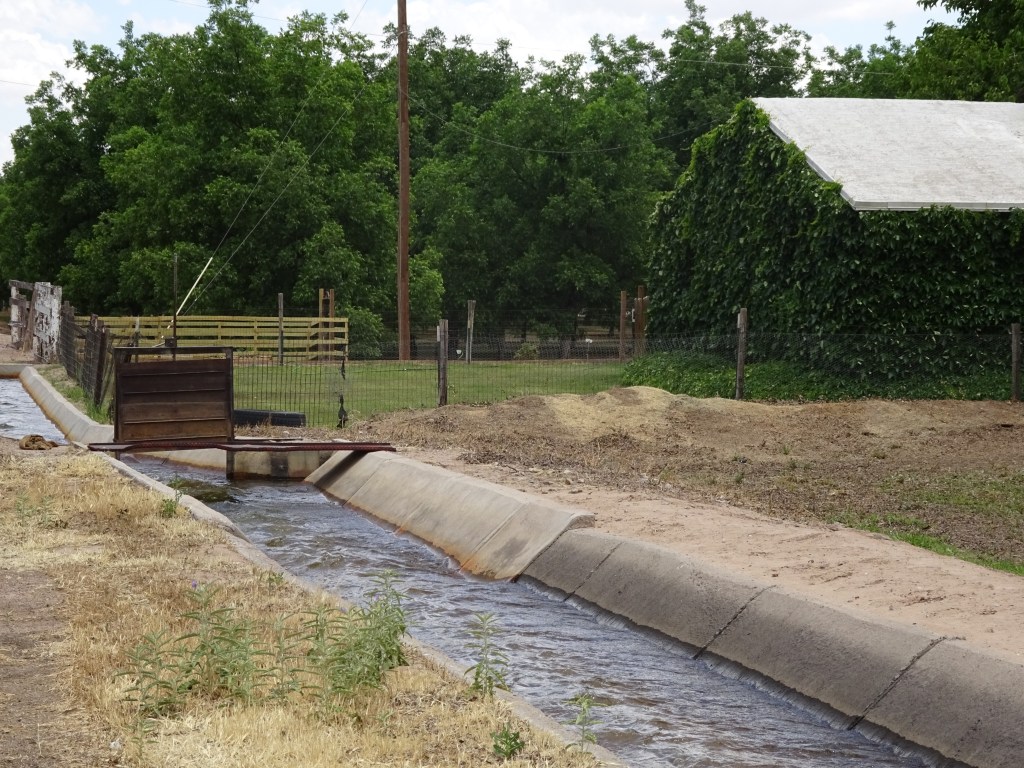
In Southern New Mexico, most farmers still use the ancient method of flood irrigation to water their fields and pecan groves. The Rio Grande River runs from north to south down the center of the state before turning east and forming part of the border between Texas and Mexico. Water is pumped from the river or wells into the mother canals and from there into smaller canals. The farmers open their gates along the way, and water rushes into the fields and floods the land.
This reminds me of St. Teresa of Avila’s analogy of the four ways that she obtained the waters of grace in prayer. In the first, she had to exert a lot of effort to draw water from the well to water the garden of her soul. In the second, devices such as the crank of a water wheel or an aqueduct allowed her to obtain more grace with less effort. (God’s help became more apparent.) In the third, her garden was irrigated with flowing water from a river or spring. (She became even more aware of God’s grace in prayer.) And finally, the Lord poured an abundance of grace on the garden of her soul with no effort on her part at all. (See The Book of Her Life, Chapter 11 et al.)
Since our gardens always need water, may God grant us the
grace to continue in prayer when it requires a lot of effort. And may He grant us the wisdom to open our
gates when He abundantly offers His gifts.
In my garden, there is a shady corner. It’s a place of refuge from the scorching sun and dusty winds.
In my daily life, the time I spend in prayer is my shady corner. There, I can let go of my cares and distractions, or at least, I can try to. I can ask pardon for my failings and experience the peace that comes from acknowledging them. I can pray for the people I love, and I can pray for the world. Best of all, I can simply enjoy the presence of the Lord who never leaves those who love Him and seek Him with a sincere heart.




 Contemplation Garden