
Gentle Reader, I invite you to enter my Easter Garden.

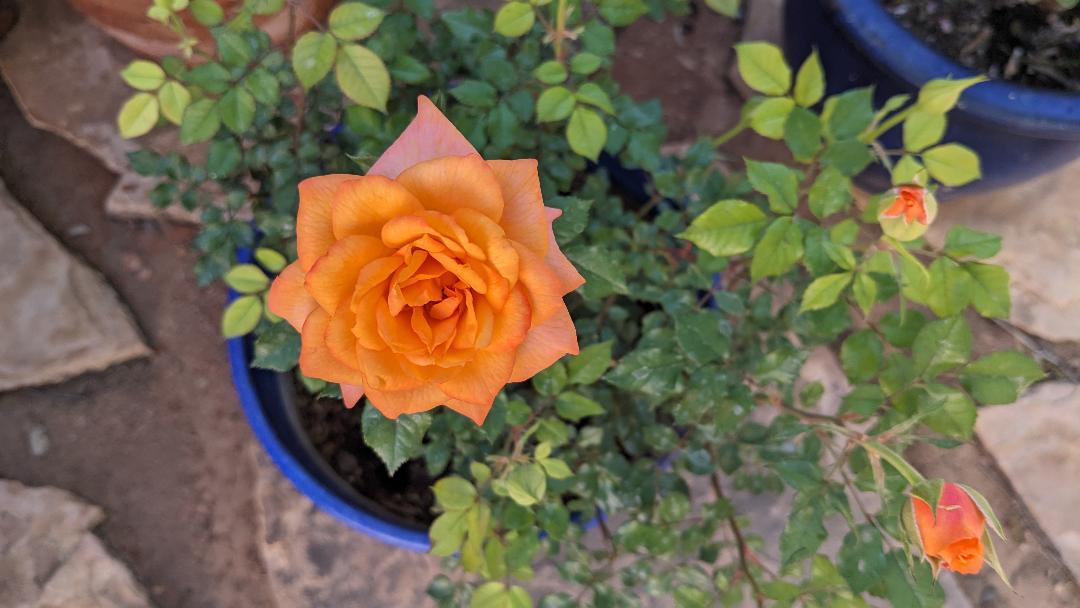

Christ is Risen! Alleluia!

“…That in me you may have peace. In the world you will have tribulation; but be of good cheer, I have overcome the world.” (John 16:33)
Pondering Hope in Everyday Moments
Gentle Reader, I invite you to enter my Easter Garden.
Christ is Risen! Alleluia!
“…That in me you may have peace. In the world you will have tribulation; but be of good cheer, I have overcome the world.” (John 16:33)


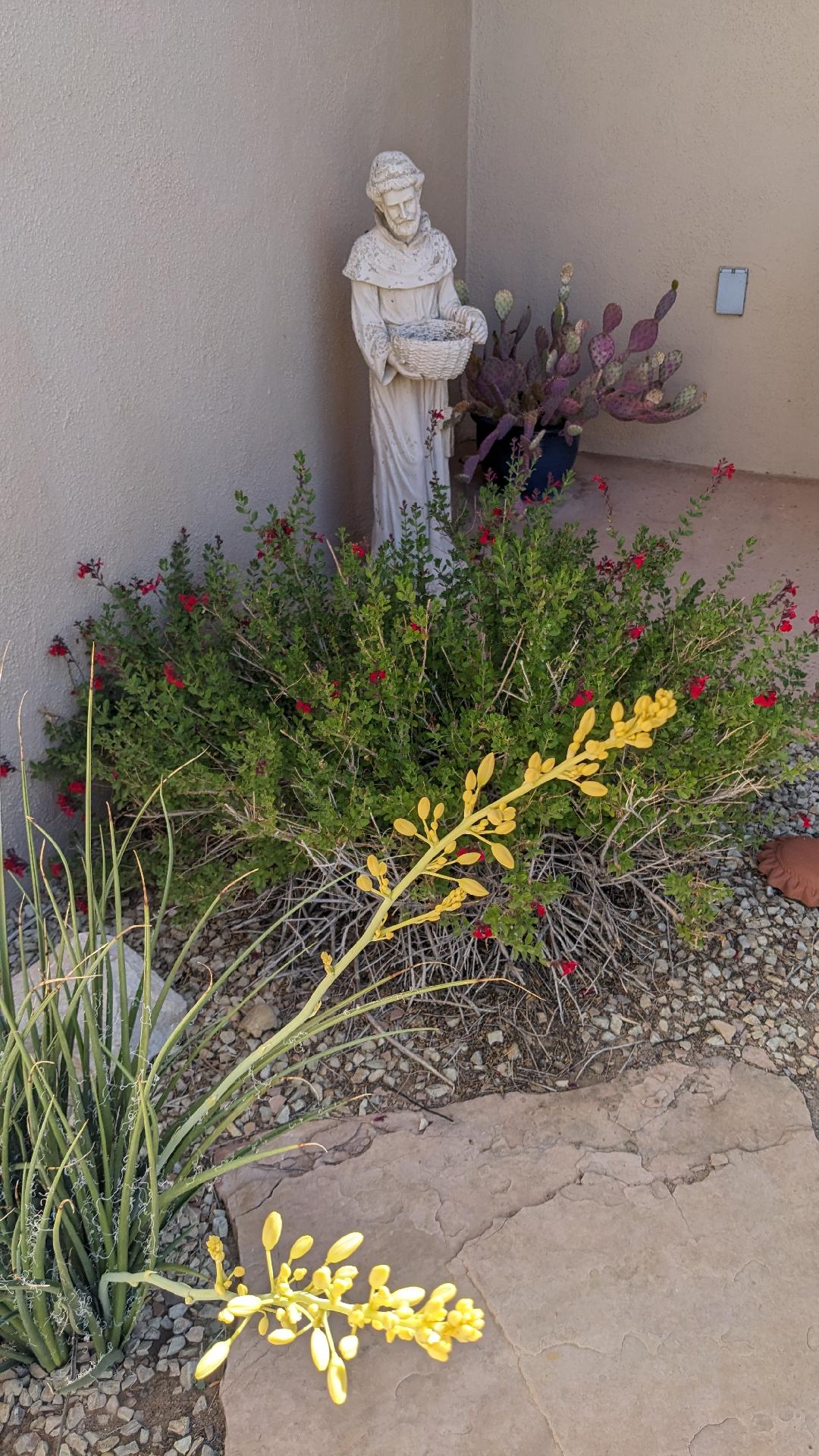
The trees are coming into leaf, and the garden is just beginning to bloom (Cherry Sage and Vinca pictured above). Baby steps.
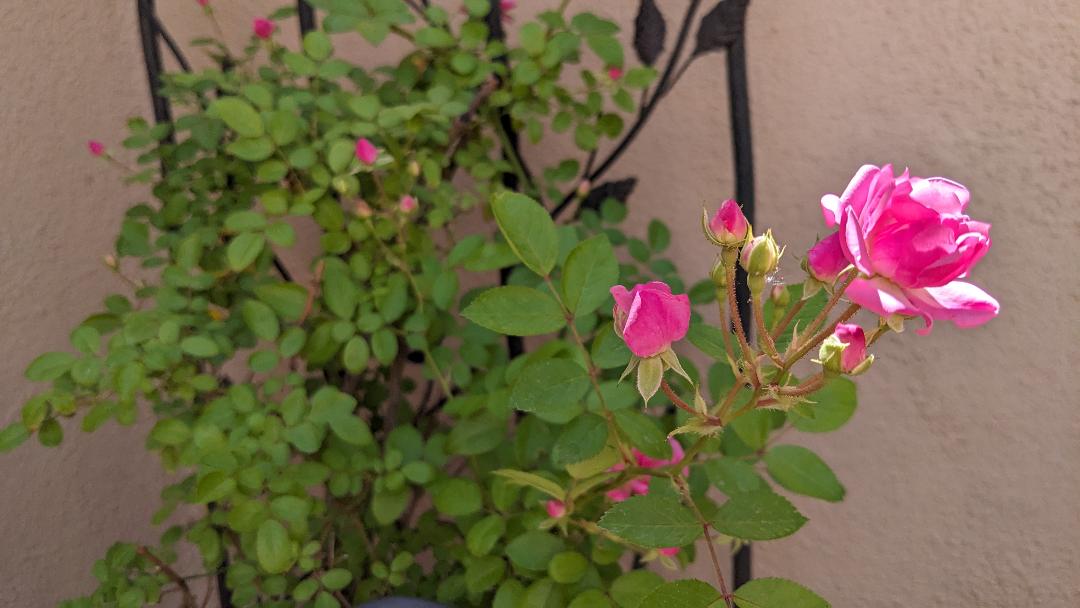
April and May will be the most beautiful months when everything comes into bloom. The roses are in bud now. They should be gorgeous in a few weeks. I look forward to making bouquets for the Blessed Virgin and the Lord Jesus.
This morning, I played my lap harp on the back porch while the birds chirped along. Were they wondering what kind of bird I am?

Gentle Reader, slowing down to rest is not easy for me. I like to be busy, to juggle multiple projects and responsibilities. Busyness gives me a sense of purpose and accomplishment, and I’m embarrassed to say, even a sense of meaning. But the meaning of my life, myself, has to be more than my activities, more than my accomplishments, such as they are. Someday, I will no longer be able to do those things. For this reason, I am grateful for the Sabbath.
After the Mass, the back porch is the perfect place to enjoy the Sabbath. There, I can hear birdsong and feel the breeze on my skin. I can ponder the gift of my life, the gift of self-awareness.
My pondering won’t result in any answers. Instead, it will remind me that there is more to life than my daily activities. It will renew my appreciation for Mystery.

The violets are in full bloom now. They always remind me of St. Therese of Lisieux. In The Story of a Soul, she uses the analogy of violets to represent all the little souls who give God joy as they strive to love Him in their everyday lives. In God’s garden, these little souls do not demonstrate the splendor of the rose or the whiteness of the lily, but they give God joy as his glance falls upon their simple beauty.
The color of violets is the color of Lent. This is a solemn season. We try to ponder the unimaginable gift that Jesus has given us in his passion. We can’t fully appreciate it or understand it. After all, we are only little souls, little violets in the face of such a Mystery.

Although many of the trees in our neighborhood are almost bare, our ash trees have only begun to shed their golden leaves. Soon the ground will be covered with a golden carpet. I am reminded of two of my favorite ‘golden’ quotes:
“All that is gold does not glitter…” (J.R.R. Tolkien, The Lord of the Rings)
“…I saw seven golden lampstands, and in the midst of the lampstands I saw one like the Son of Man, clothed with a long robe and with a golden sash across his chest….” (Rev. 1:13, NRSV, Catholic ed.)
Advent is a time of expectation, a time of waiting for all that is good and beautiful. Here’s to the once, present, and future King!
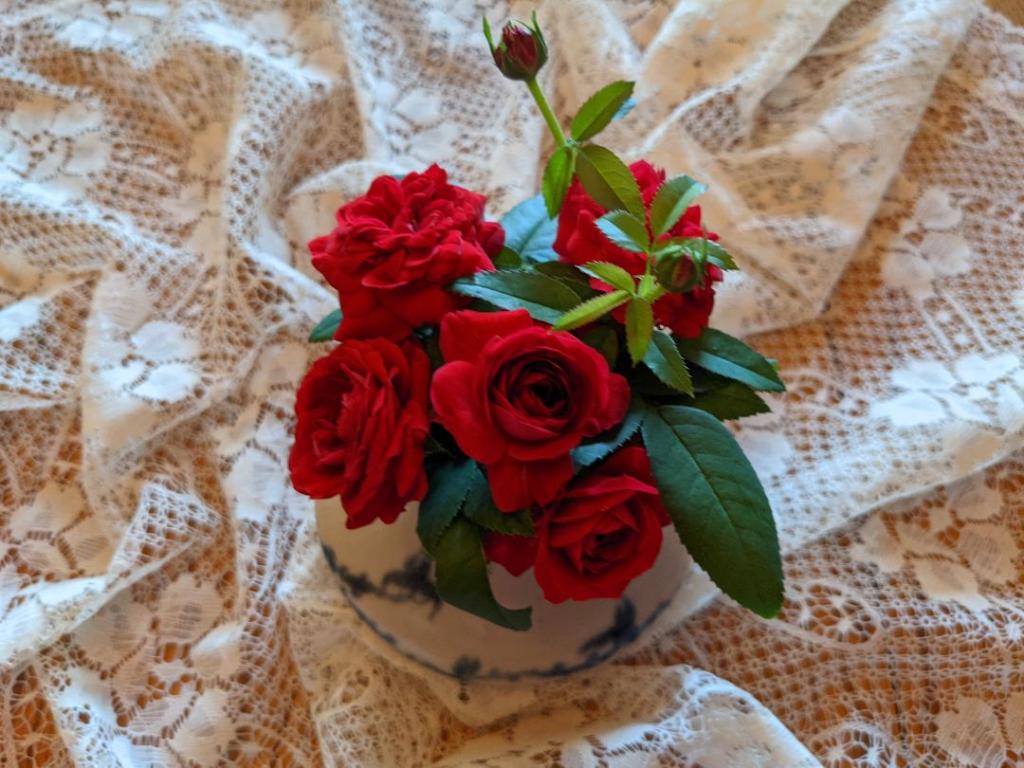
“Listen to me, my faithful children, and blossom like a rose growing by a stream of water.
      “Send out fragrance like incense, and put forth blossoms like a lily.  Scatter the fragrance, and sing a hymn of praise; bless the Lord for all his works.”  (Sir. 39:13-14, NRSV Catholic Ed.)
I love this passage from the book of Sirach. God seems to be saying that I can be more than I am in the present moment, more than I can desire or even imagine. This resonates in my heart, and I believe it is true. I want to be like the rose or the lily that gives off a lovely fragrance to the world. I want my life to be a hymn of praise that blesses the Lord who made me and who sustains my life.
At the same time, I am aging. I see an old woman in the mirror. I am not as strong as I used to be. There are more years behind me than before me. Yet my desire to become something more is as strong and vigorous as if I were a young woman with my whole life ahead of me.
St. Therese of Lisieux wanted to be a saint, and at the same time, she was realistic about her limitations and her situation. She didn’t think she was made of the stuff of great saints (although it turned she was), but she believed God would not have given her the desire to become a saint unless it was possible for her to achieve that goal.
I can’t compare myself to St. Therese, but I may still have something beautiful to offer to the world. I may still have some unopened petals, but in order for them to open, I need to remain near the stream of running water. For me, that stream is the mysterious life that flows from the opened side of the Savior, from the side of the one who gave his life for me so I could have life, so I could be life in myself and for others.
At the end of my life on earth, when my last petal has fallen to the ground, I hope to enter into a greater life, an eternal life with the Lord who has loved me so dearly in this earthly life of preparation. I look forward to being with him forever in that abundant life – ever fresh, ever radiant, ever blessed.
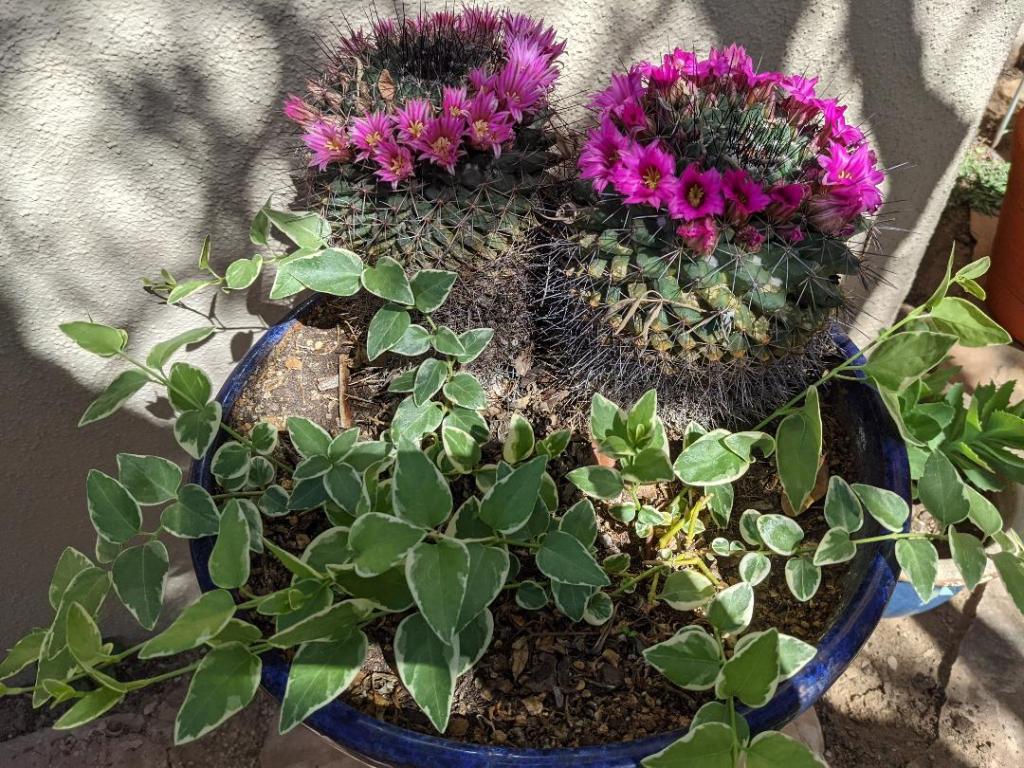
My cacti are blooming just in time for Good Friday. The prickly spines remind me of the crowning of thorns and bitter suffering of Jesus, but the lovely blossoms suggest resurrection — the resurrection of Jesus and the resurrection that each of us ultimately longs for.
The Vinca (Periwinkle) vines are bursting with new life. I started the plants last summer as small cuttings from another pot. All of my other pots were occupied at the time, so I stuck the tender shoots into the pot with the cacti. I wondered how they would get along.
They seem to like each other.
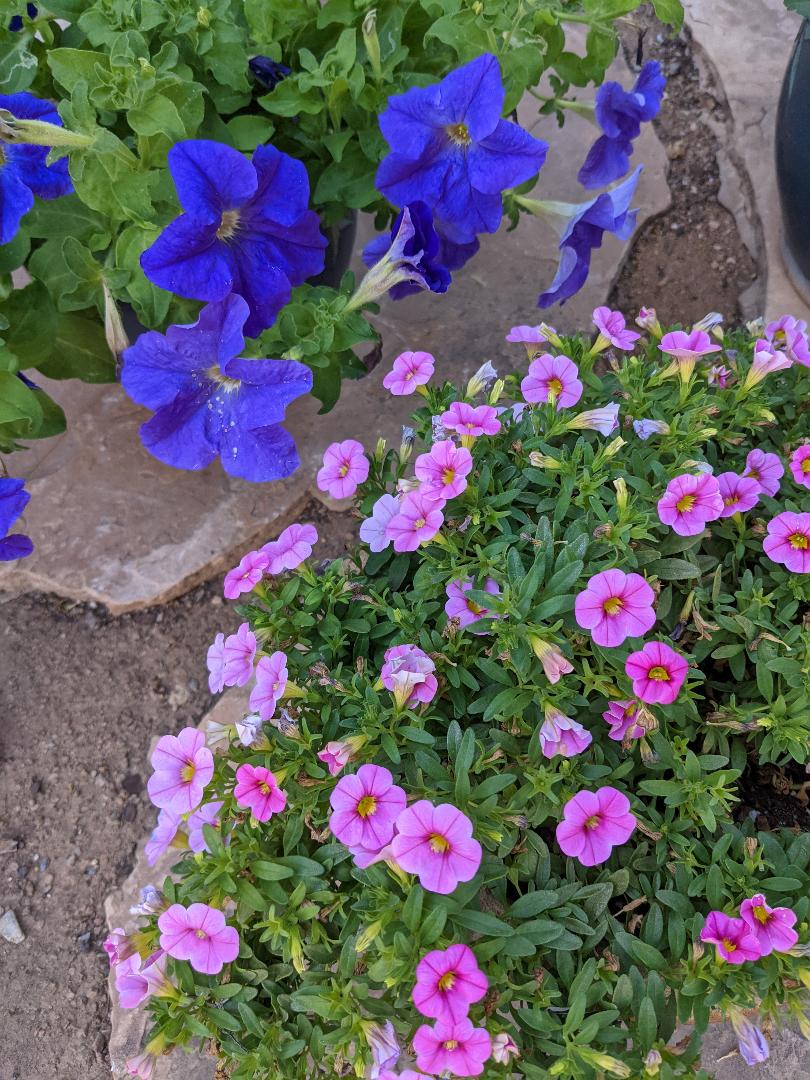

This morning after the Corpus Christi Mass, celebrating the Real Presence of Jesus in the Holy Eucharist, my garden looked particularly lovely. Pictured above on the left: Petunia and Calibrachoa. On the right: Sweet Potato Vine, Rose, and Lobelia.
On this Good Friday, I offer the following blank verse in remembrance of Our Lord’s Passion:
The Crown of Thorns
By Lynn Miyake, OCDS
The two were slaves who happened to be near.
The soldiers made them weave the crown of thorns,
And as they twisted prickling vines, the thorns
Tore open fingers, palms, and fumbling thumbs.

The soldiers nodded, pointed then at Him.
The slaves, they placed the crown upon His head,
And vicious thorns, they pierced His sacred brow --
The Blood ran down upon their bleeding hands.

The Precious Blood, it mingled with the blood
Of slaves. Then Jesus caught their gaze and looked
At them with love, WITH LOVE, as if to say,
We now, at last, are altogether one.

(This post was originally published back in March. Here it is again for the Christmas Season.)
Have you ever heard that the date for Christmas (December 25) was selected to coincide with a pagan holiday? Don’t believe it. The calculation is actually based on Scripture.
Every year on March 25, the Church celebrates the day when the Angel Gabriel announced the conception of the Christ to Mary. March 25 is exactly nine months prior to December 25. To see how the date for Christmas was calculated, first we need to go back to September 25, when the Angel Gabriel announced the birth of John the Baptist to Zechariah. (Remember, during the Annunciation to Mary, Gabriel tells Mary that her cousin Elizabeth has also conceived, and Elizabeth is in her sixth month. See Luke 1:36. September 25 is six months prior to March 25.)
September 25 fell at the end of the Jewish season of Yom Kippur, the Day of Atonement. (The date for the Day of Atonement falls on the tenth day of the seventh month of the Hebrew calendar. It varies from year to year, falling in September or October.) During the ten day period prior to the Day of Atonement, Jews amended their behavior, prayed, repented, and gave to charity, in order to seek forgiveness from God.
According to Luke 1:9, Zechariah was chosen by lot to enter the sanctuary to burn incense. The Jewish priests could only enter the Holy of Holies once a year on the Day of Atonement. (See Ex. 30:7-10.) Gabriel says to Zechariah, “Do not be afraid, Zechariah, because your prayer has been heard. Your wife Elizabeth will bear you a son, and you shall name him John.” (Luke 1:13)
So, here is the timeline:
There you have it, Gentle Reader.
 Contemplation Garden